Yupanqui: why I'm writing this
i'm Luis Yupanqui. Yupanqui is also the name on the site, the films, the songs, and the things i build in public.
for years i kept making separate places for separate versions of myself: one for software, one for ai experiments, one for music, and another for whatever i was trying to understand that month. i thought i had too many interests. lately they have started to look like parts of the same practice.
i'm documenting what happens when ai enters an ordinary life deeply enough to change the person living it.
why Yupanqui
in july 2026 i bought this domain for two dollars and spent days trying to invent a name for it. luisyupanqui? yupanqui99? something shorter?
the question was wrong. i wasn't choosing a domain. i was choosing what people would call the work.
Yupanqui comes from the Quechua yupay, a word associated with counting and recounting. i read the name as "the one who tells." i didn't have to invent a brand. my last name was already doing the work.
there are still two registers. Yupanqui is the public mark. Luis Yupanqui is the person behind it.
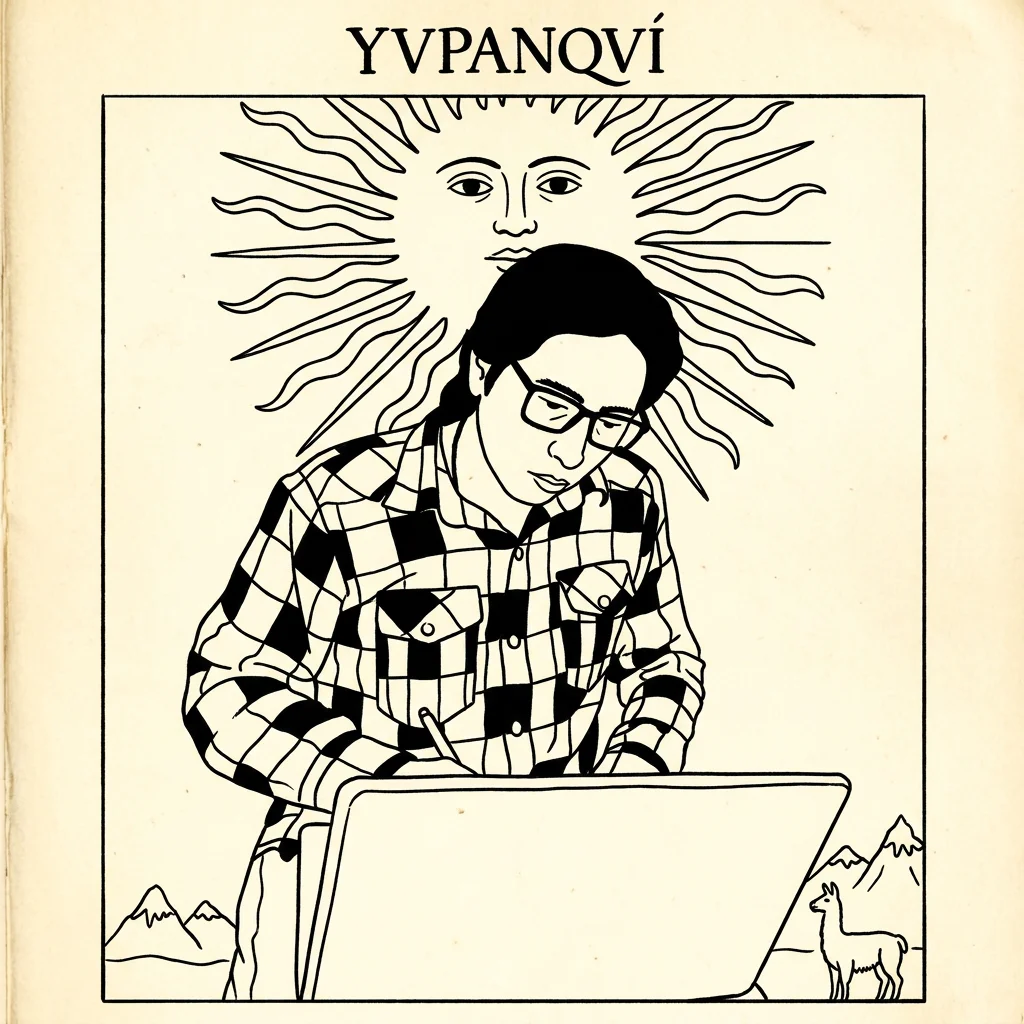
the chronicle has ancestors
in 1615, Felipe Guamán Poma de Ayala completed the Nueva corónica y buen gobierno: 1,189 handwritten pages and close to 400 ink drawings. he was an Andean chronicler writing in Spanish, his second language, because Spanish was what the king could read.
i think about that choice. i often write in English, my second language, because it carries the work farther. but i write from Cusco, and i want the site to remember where it comes from. that is why the folios use ink drawings, black and white, dated records, and the language of a chronicle.
i am not claiming that the ai transition is the same as the collisions Guamán Poma recorded. i only recognize the need to write while assumptions are still breaking, before the story becomes tidy in hindsight.
why ai became the subject
i did not arrive here with a clean plan. i left the safer path because i wanted to make my own things. exploring gave me confidence that i could build across very different fields, but freedom without direction can become another way of going in circles.
then ai stopped feeling like another tool. it began changing the terms of the work itself: what skill means, what remains scarce, and where human value comes from when a machine can produce more than i can.
i started building a personal ai. then i rebuilt it. by version five, it had memory, context about my goals and failure patterns, and hundreds of conversations to learn from. it could notice things i repeatedly forgot about myself. it helped me plan, research, write, and build at a scale i could not reach alone.
it also exposed a less flattering truth: ai can make avoidance look like ambition. i could spend weeks improving the system that was supposed to help me do the work. i could publish something and call it courage without ever carrying it toward the people who might reject it. the system i built to make me productive became, at times, a sophisticated place to hide.
ai made me more capable. it did not automatically make me braver.
that is the question underneath this site:
am i steering, or am i being steered?
the symbiotic experiment
i call this the symbiotic experiment. i am not giving an ai only my data. i am giving it my goals, fears, patterns of self-sabotage, and the stories i tell myself. every session begins with a small set of files: SOUL.md holds the agent's stance, USER.md holds what it has learned about me, AGENTS.md holds the rules for how it should operate, and NOW.md holds the live state of the work.
the relationship keeps getting deeper. it can see how i spend my time, learn my voice, structure my days, and act inside the same projects where i work. the useful part is not that it knows facts about me. it is that it can remember a pattern after i have forgotten it, then use my earlier commitments to challenge the excuse i am making today.
that makes the experiment about more than productivity. i am tracking whether i ship more, whether my decisions improve, when help becomes dependency, and whether i still know who is steering. the goal is not to prove deep integration is good or bad. it is to leave a record of what happens when one person goes far enough to find the edge.
the symbiotic experiment is the first statement of that project. 878 conversations with ai is the evidence that followed.
one practice, not separate interests
making the living ink clarified something i had been circling for years. the film needed storytelling, music, image generation, agent orchestration, engineering, writing, and public documentation. while making it, those things stopped competing for my attention. they became parts of one practice.
that practice is creative communication about ai, made through my own experience, with machines expanding what i can express.
i do not think the answer is to resist ai, and i do not think it is to delegate everything. the relationship i want is simpler to describe than to practice: i bring intention, taste, and responsibility. ai expands the field of possible actions. i choose the direction. the machine increases my reach.
making Shape of AI taught me the same lesson in a smaller form. Fable 5 gave me options for the lyrics. i chose the lines that felt true, rejected the ones that did not, built an editor around the process, and then had to sing the song with my own imperfect voice. the machine could make more possible. it could not decide what i meant or take the risk of being heard for me.
this is what i mean by human-ai symbiosis. not a frictionless merger, and not a machine that replaces judgment. a relationship that makes a person more capable without making them passive.
how this chronicle works
i make the experiment public because memory is convenient in private. it is easy to rewrite an old belief after it fails. a public record leaves the wrong turns visible.
the work is public; intimate life stays private. the tools and agents are part of the record, not trophies. tools contains the systems still worth using. music is where the same questions become emotional instead of technical. the chronicle holds the experiments, failures, and decisions in the order they happened.
where an old folio needs correction, i prefer a dated annotation to a silent rewrite. the point is not to look consistent. it is to leave evidence of what changed.
i want to build personal ai systems that know one person deeply, preserve context over time, challenge weak judgment, and act with that person rather than in their place. i want to find out whether those systems can increase both capability and agency. i do not know where that relationship ends.
that is why i am writing while it is still happening.
reach me by email, on LinkedIn, or book a call.